
The twelve steps to my front door – Lou's NET story
Lou was tramping New Zealand's toughest Great Walks in March. By April, twelve steps to her front door were a struggle. A 15 cm pancreatic NET, a second tumour on her kidney, and the symptoms she had spent years putting down to menopause.
Written by Lou
My name is Lou. I am a 54-year-old Māori woman of Kāi Tahu, Kāti Māmoe, Waitaha and Ngāti Hikairo descent.
In November 2025, I left my role as a Customer Transformation Manager without another job to go to. Instead, I spent the summer doing the things that nourished me. I built a rock retaining wall, planted an edible garden, camped beside Lake Wānaka, climbed Roys Peak, and completed many other walks.
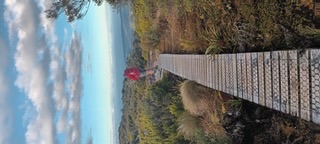
In March 2026, my partner and I were immersed in the breathtaking scenery, lush native bush, and birdsong while tramping the Humpridge Track, one of New Zealand's toughest Great Walks. Four weeks later, we were due to walk the Milford Track with our whānau, one of New Zealand's most iconic Great Walks. I felt fit, strong and ready for another adventure.
Then, in April 2026, everything changed.
Then, in April 2026, everything changed
I started experiencing severe leg cramps. These weren't the usual calf or foot cramps, they were deep in my inner thighs and excruciating. I also became increasingly short of breath. The twelve steps up to my front door became a struggle.
At first, I thought I had picked up a virus, so I visited my GP and jestingly told her she had one week to get me fit enough for the Milford Track.
Six hours after my blood test, she called to tell me I was anaemic, which explained the cramps and breathlessness. As I wasn't experiencing any obvious blood loss, she referred me for further investigation. Around the same time, I had to tell my whānau that I would no longer be joining them on the Milford Track.
While my whānau were on the Milford Track a week later, my partner called an ambulance after I suddenly vomited large blood clots. I couldn't believe what I was seeing. I felt nauseous, confused and incredibly weak.
Lying in the Emergency Department after receiving two units of blood, I was convinced I had a bleeding stomach ulcer. The doctors admitted me while they investigated further.
The following day, an endoscopy revealed that the problem wasn't coming from inside my digestive tract. Instead, something outside was pressing against my stomach, so I was sent for a CT scan.
What the scan found
The scan revealed the cause: a 15 cm pancreatic neuroendocrine tumour (NET). It had shattered my spleen and, as if that wasn't enough, a second tumour, a 7 cm renal cell carcinoma was discovered on my left kidney.
The medical team had initially suspected the pancreatic tumour was something else, so they decided to perform a biopsy before proceeding. The biopsy confirmed it was a pancreatic NET, giving the team the information they needed to plan the right treatment. Most importantly, they believed it was operable.
The emotions were overwhelming. There were tears of despair as we came to terms with two cancer diagnoses, followed by tears of relief when we learnt surgery was possible. Hope and fear seemed to exist side by side, and I quickly discovered that you can never underestimate the emotional roller coaster that comes with a cancer diagnosis and the uncertainty of what comes next.
Scanxiety, and a seven-hour operation
Before surgery, I underwent an additional PET scan to determine whether the NET had spread elsewhere in my body. The scanxiety was intense. Surgery was scheduled for the following week, and I couldn't help thinking that if the scan showed the cancer had spread, everything could change, including whether surgery would still be an option.
When the results came back, they gave us something to celebrate. The cancer had not spread, and for the first time since my diagnosis, I felt confident enough to move forward with surgery.
In May 2026, I underwent a seven-hour operation.
During surgery, the remaining part of my spleen, part of my pancreas, my kidney, and a small part of my stomach were removed.
Recovery was about far more than healing from surgery. I was managing significant pain, adjusting to the reality of a large scar stretching across my abdomen, and grieving the loss of parts of my body. I hadn't expected to mourn my organs, but I did. It was another part of the journey that no one had prepared me for.
Where we went for information
From the very beginning, my partner and I made a conscious decision not to Google anything. Instead, we relied on Neuroendocrine Cancer New Zealand for information. Having a trusted New Zealand source gave us confidence at a time when everything felt uncertain. The website became our lifeline. I read the personal stories, signed up for updates, and found comfort in knowing others had walked this path before me.
I will always be grateful that Neuroendocrine Cancer New Zealand was there when we needed it most. Having reliable information, shared in a way that was easy to understand, helped us navigate one of the most frightening times of our lives.
Now, in July 2026, as I continue to recover, I find myself reflecting on everything that has happened.
Looking back
I accepted these changes as part of getting older, never imagining they were being caused by two tumours growing inside me.
Hindsight is a wonderful thing.
Only now does everything make sense.
After two rounds of testing ruled out coeliac disease, gluten and dairy intolerance, I was told I had IBS.
Looking back, I can see that many of the symptoms I attributed to menopause weren't menopause at all. The fatigue went unnoticed. My performance as a Masters rower steadily declined, and I increasingly chose the coach boat over a rowing seat. Gardening became just that little bit harder. After work, I would fall asleep almost as soon as I sat down at 5 p.m. I found myself losing patience over things that I would normally have handled without fuss. I accepted these changes as part of getting older, never imagining they were being caused by two tumours growing inside me.
Looking back, I now understand why I walked away from my career.
I told my Chief Executive that I no longer felt capable of doing the role to the standard I expected of myself. She reassured me that I was doing a great job, but I couldn't see it. The expectations I placed on myself felt impossible to meet, and inside I was struggling more than anyone realised.
I began experiencing passive suicidal thoughts. They weren't driven by a desire to die, but by a relentless sense of hopelessness that I simply couldn't shake. I didn't tell anyone what I was experiencing because I couldn't explain it myself. At the time, it never occurred to me that they might be connected to what was happening inside my body.
What lifted when the tumours came out
Since my tumours were removed, the IBS that had plagued me for almost ten years has disappeared. So have the unexplained anxiety and the passive suicidal thoughts.
I feel incredibly fortunate. Removing the tumours didn't just save my life, it gave me back a sense of myself that I didn't realise I had lost.
Recovery continues, one day at a time. Some days are slow, projects remain on hold, and healing demands patience. My body has changed and so has my perspective. While I don't know exactly what the future holds, I do know this: I am deeply grateful for my partner, my whānau, my friends, my medical team, and for Neuroendocrine Cancer New Zealand, whose support and information helped us navigate the unknown.
There are many others still living with NETs, facing uncertainty every day, and I feel deeply for them. If sharing my story encourages even one person to listen to their body, ask more questions, or feel less alone, then telling it has been worthwhile.
Ngā mihi nui
Lou
A note from NECNZ: Lou writes here about passive suicidal thoughts. If any of this is close to home, you don't have to sit with it on your own. You can free call or text 1737 any time to talk with a trained counsellor, or talk to your GP or your treating team. In an emergency, call 111. Avril, our NET nurse specialist, is also here – you can book a call with her, free.
Related resources
More like this → Video
VideoChris's NET journey
Chris's NET cancer experience has created more upsides to his life than downsides. This is his story.
 Video
VideoJohn's story
John shares his experience of living with neuroendocrine cancer.
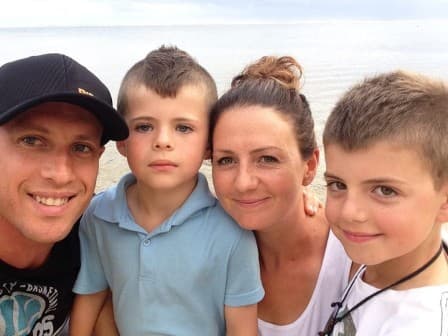
Multiple Endocrine Neoplasia Type 1
NECNZ founder and former CEO shares her NETs story
15 years since diagnosis - Dave's NET Story (part 2)
Dave's NET story, part 2 – reflections fifteen years on from diagnosis, on living well with neuroendocrine cancer.