
Current research on MEN1
New Zealand researchers led by Dr Ana Ramachandran are uncovering how different MENIN isoforms help or hinder tumour development in MEN1 – the first in a growing strand of NET research on the site.
Written by NECNZ team, with Dr Ana Ramachandran & Alex McLean (University of Auckland)
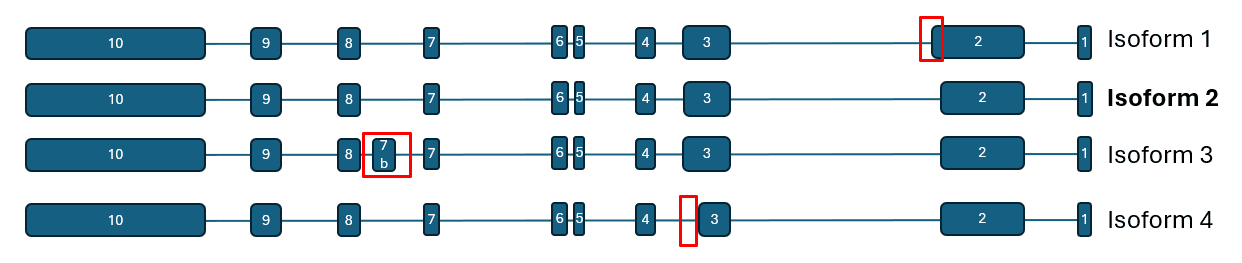
The inherited genetic condition MEN1 occurs when a person has one faulty copy of the MEN1 gene. During their lifetime, their "good" copy of the MEN1 gene can also develop mutations, which increases their risk of tumours. The MEN1 gene tells the body how to produce a protein called MENIN, which plays a role – one we don't yet fully understand – in helping to prevent tumours from forming.
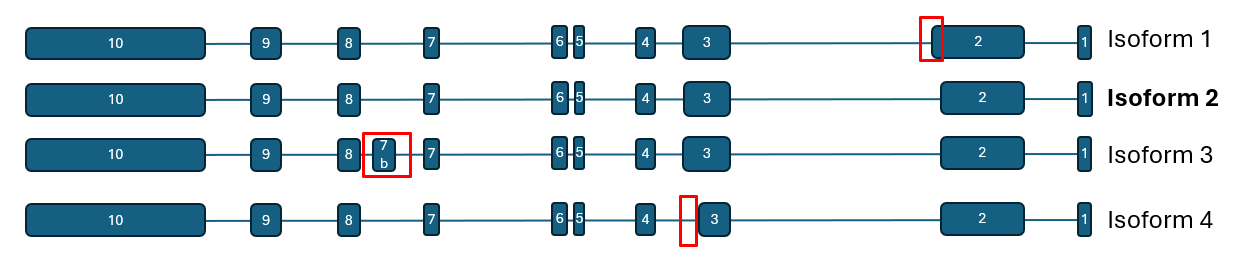
We now know that the MENIN protein is made up of building blocks that can be put together in different ways, creating different versions of the protein. These different versions are called isoforms. The MEN1 gene contains sections that code for the protein (called exons) and sections in between (called introns). In splicing, exons 1 to 10 are joined together. In alternative splicing, the exons are joined together in different ways – much like Lego blocks can be assembled in different ways.
New Zealand researchers, led by Dr Ana Ramachandran, have shown that there are at least four different MEN1 isoforms (Figure 1) that differ in how the exons are assembled (red boxes). Isoform 2 is the reference isoform; Isoform 1 contains a larger second exon; Isoform 3 contains a novel exon (exon 7b); and Isoform 4 has a shorter exon 3. The resulting protein isoforms can have extra sequences, or may lose some critical domains.
Sometimes, knowing the shape of a protein helps to predict how it might work. But MENIN doesn't resemble other known proteins, which means researchers need to use other tools to unravel how it works – such as looking at how it interacts with other proteins. MENIN can interact with partner proteins along its entire length. This tells us that having different MENIN isoforms might affect how it interacts with those partners. For example, Isoform 4 is missing the part of MENIN that interacts with SMAD3 – a protein involved in telling MENIN to stop tumours from growing (Figure 2).

Ana's research is discovering how different isoforms of MEN1 help or hinder tumour development. By understanding what's happening at the cellular level, Ana hopes her research will one day help to join the dots between a patient's genetics and how, where, and when their tumours might begin.
Thanks to Dr Ana Ramachandran and Alex McLean, a PhD student at the University of Auckland, for assisting with this overview.
References
- Brandi, M. L., Agarwal, S. K., Perrier, N. D., Lines, K. E., Valk, G. D., & Thakker, R. V. (2021). Multiple Endocrine Neoplasia Type 1: Latest Insights. Endocrine Reviews, 42(2), 133–170. https://doi.org/10.1210/endrev/bnaa031
- Brandi, M. L., Pieterman, C. R. C., English, K. A., Lines, K. E., Shariq, O. A., Marini, F., Cuny, T., Lewis, M. A., Stratakis, C. A., Perrier, N. D., Waguespack, S. G., Castinetti, F., Valk, G. D., Thakker, R. V., Arnold, A., Bartsch, D. K., Beckers, A., Bertherat, J., Bhadada, S. K., … Lei, Y. (2025). Multiple endocrine neoplasia type 1 (MEN1): recommendations and guidelines for best practice. The Lancet Diabetes & Endocrinology, 13(8), 699–721. https://doi.org/10.1016/S2213-8587(25)00119-6
- Caesar-Johnson, S. J., Hutter, C. M., Sun, Q., Wu, Y., Gehlenborg, N., Zhang, H., … Rubin, M. A. (2018). Comprehensive Analysis of Alternative Splicing Across Tumors from 8,705 Patients. Cancer Cell, 34(2), 211–224.e6. https://doi.org/10.1016/j.ccell.2018.07.001
- Google. (2026). Gemini [Image generator]. https://gemini.google.com
- Ramachandran, A., Le Quesne Stabej, P., Boyle, V., Elston, M. S., Pattison, S., Lawrence, B., & Print, C. (2024). Alternative splicing generates isoform diversity in MEN1. Endocrine Oncology, 4(1), 240014. https://doi.org/10.1530/EO-24-0014
Related resources
More like this →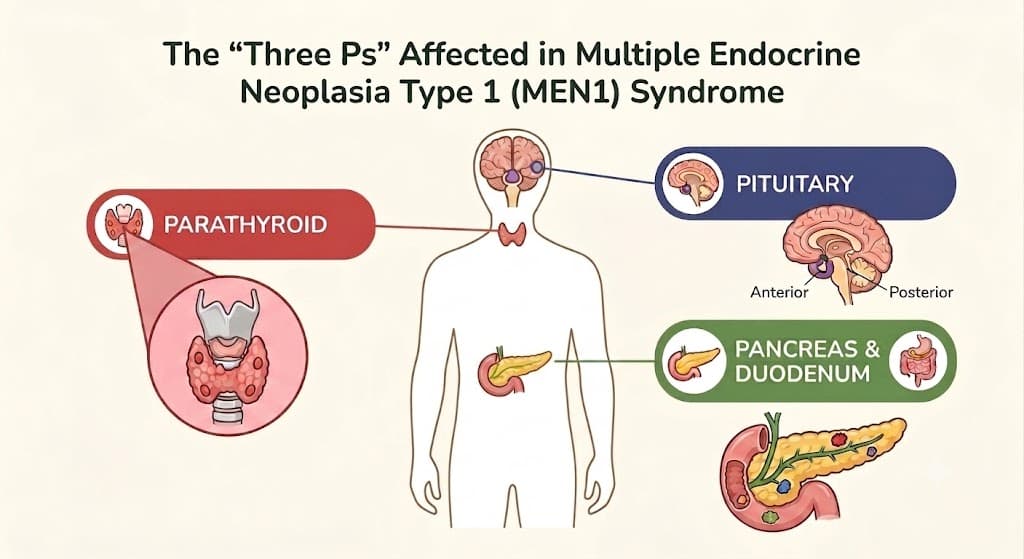
MEN1 syndrome (Multiple Endocrine Neoplasia type 1)
MEN1 is a rare inherited condition that causes tumours in the endocrine glands – the parathyroids, pituitary and pancreas. What it is, what causes it, and how it is diagnosed.
Current research on hereditary phaeochromocytoma and paraganglioma (PPGL)
A University of Auckland team is working on earlier detection of hereditary PPGL and on new therapies for SDHB-mutated tumours – the gene mutation most often found in New Zealand patients, and more often in Māori.